


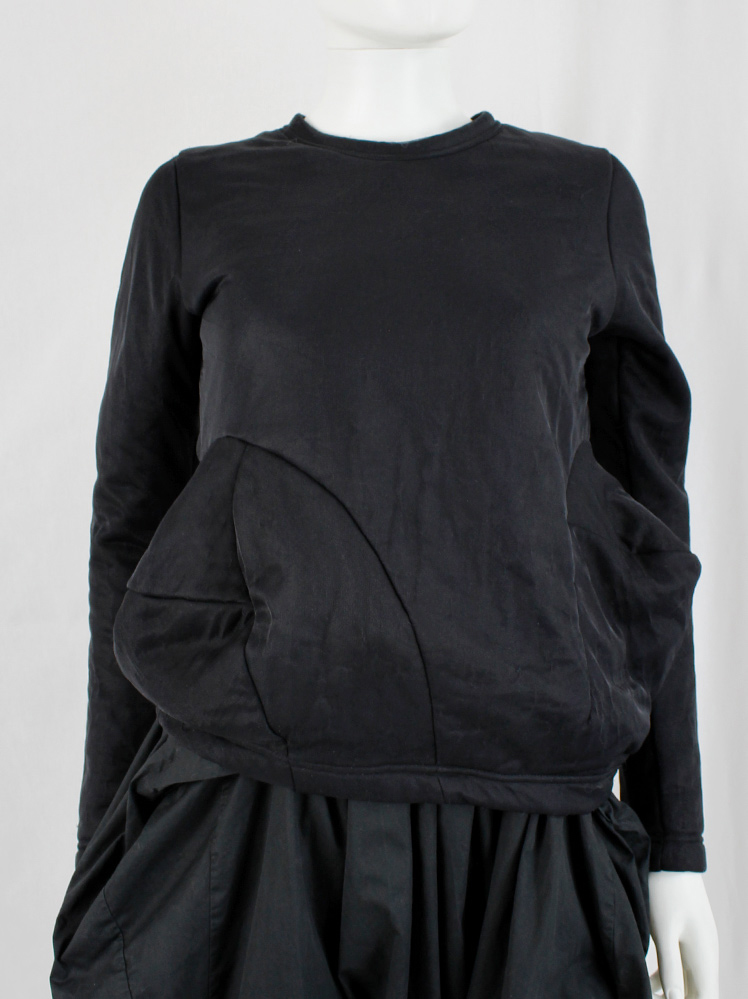


Description
Similar items


-

Rick Owens VICIOUS black geometric top with structured side wings and longer back — spring 2014
-

Maison Martin Margiela grey two-dimensional jumper with circular neckline — fall 1998
-

Noir Kei Ninomiya white shirt with chain and large pearls on the collar — spring 2017
-

A.F. Vandevorst grey wrinkled bustier with ‘fly away’ effect — spring 2015
About Rei Kawakubo
Rei Kawakubo is a Japanese fashion designer, however, she didn’t study fashion but fine arts and literature at Keio University in Tokyo.
After graduation, she worked as a stylist before launching her label Comme des Garçons. Going against the 1980s super feminine look, she sent an all black, deconstructed collection on the runway, dubbed “anti-fashion” and “Hiroshima Chic” by easily shocked and insensitive journalists.
During the 1980s, her garments were primarily in black and dark grey or white. By the time of her Paris debut in 1981, Kawakubo was so famous that her fans were dubbed ‘the crows’ in the Japanese press.
Comme des Garçons kept on growing, evolving into a Comme de Garçons ‘world’ with about 20 distinct lines. This also gave Rei Kawakubo the possibility to give employees their own line, like Junya Watanabe, (the now discontinued) Tao Kurihara en the recently added Noir by Kei Ninomiya.
Kawakubo specializes in anti-fashion; producing deconstructed garments, which are draped around the body in an asymmetric shape, making them look awkward and uncomfortable. The hems are often unfinished and frayed.
Rei Kawakubo is reclusive and doesn’t give many interviews, she let’s her creations speak for themselves. She is know as a fashion icon and influence for designers like Martin Margiela, Ann Demeulemeester and Helmut Lang which have all name checked Kawakubo as an inspiration.


